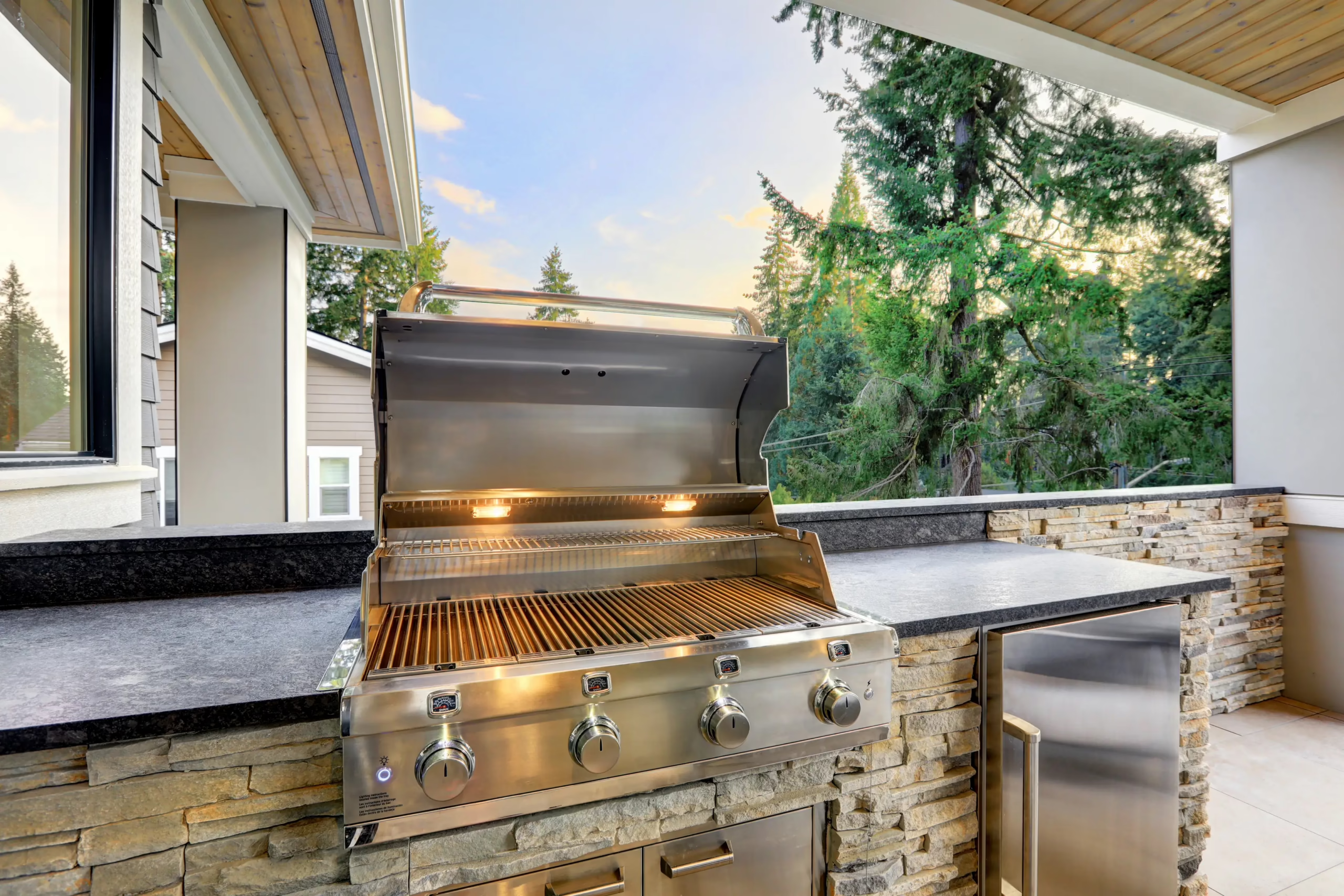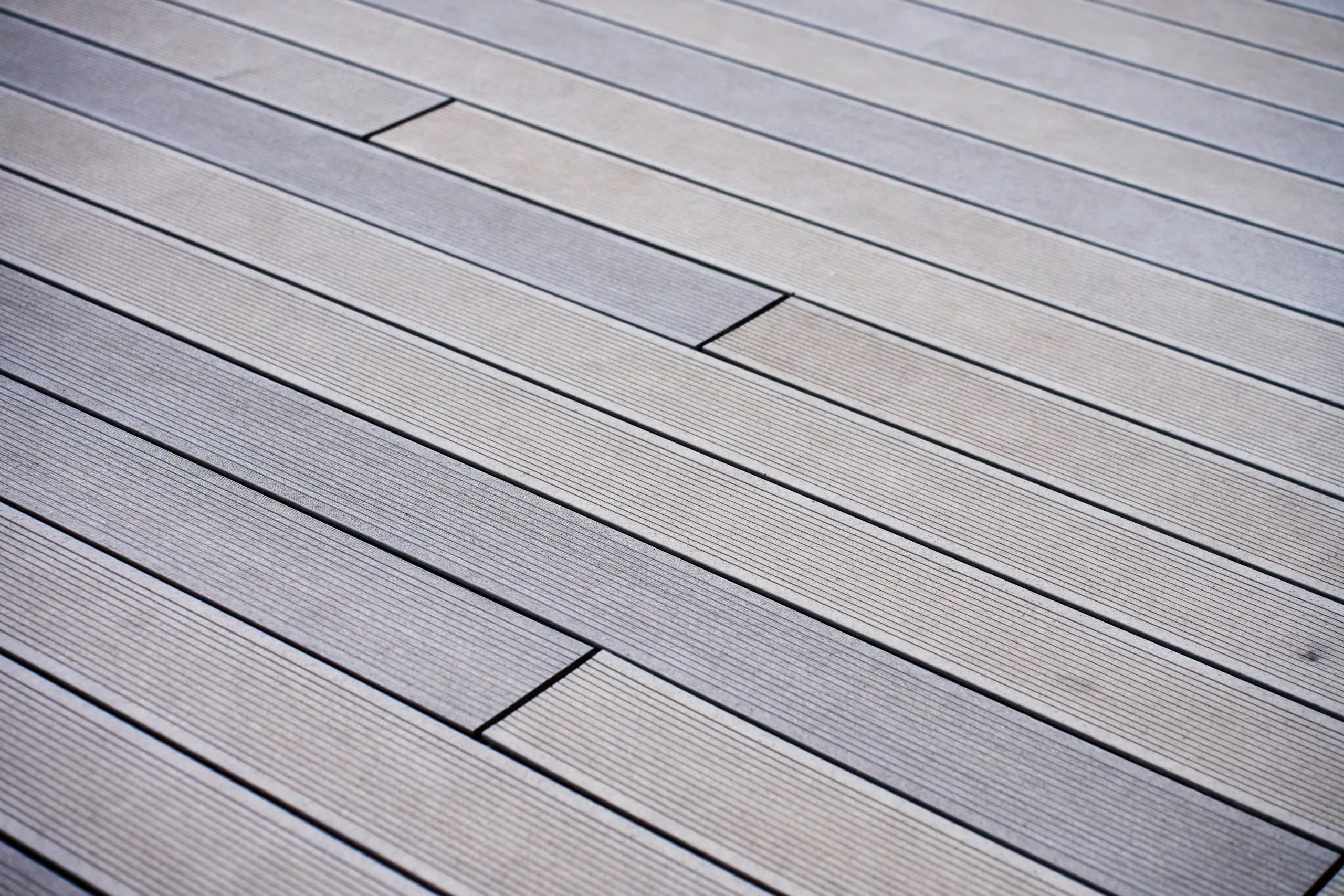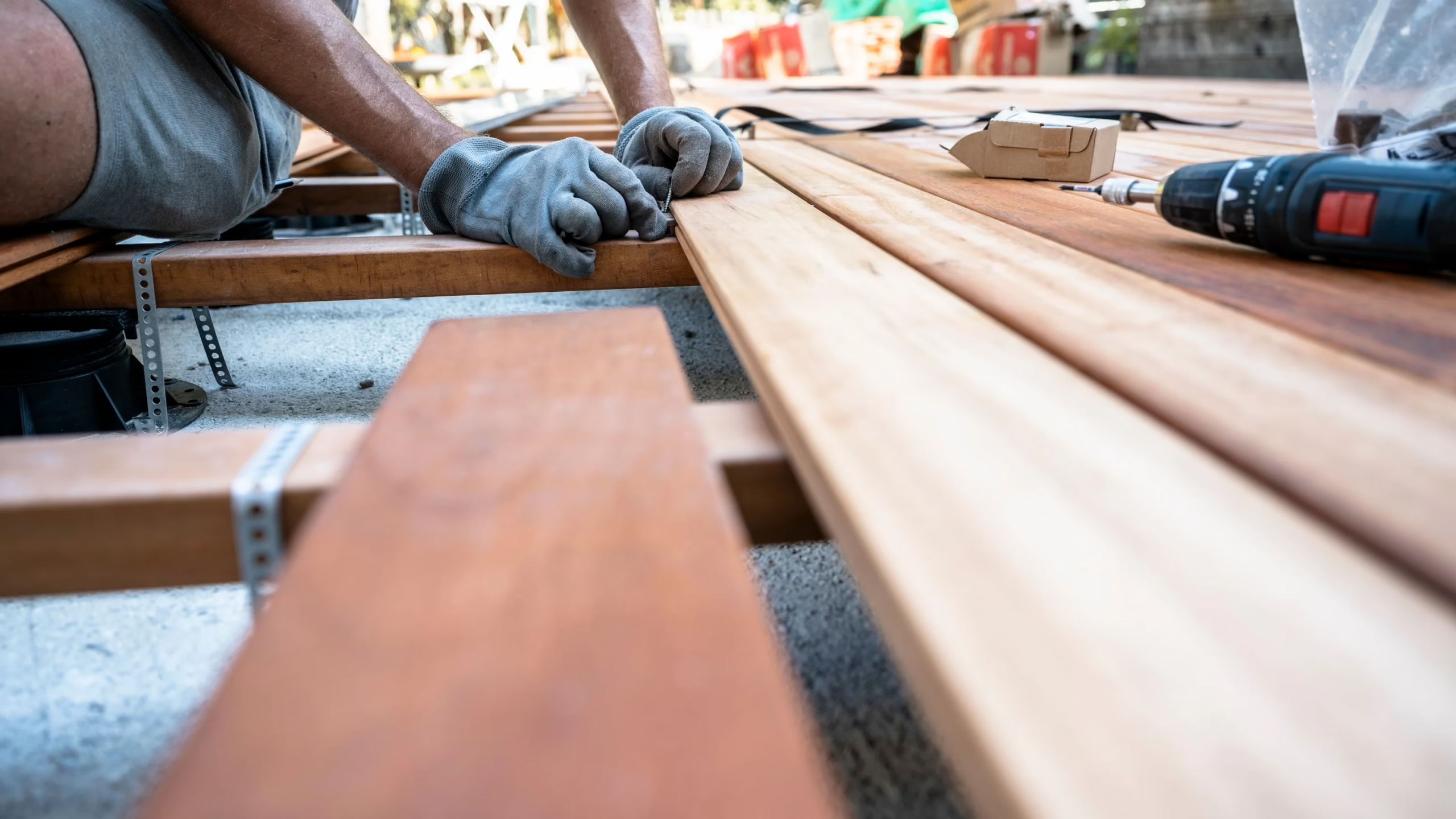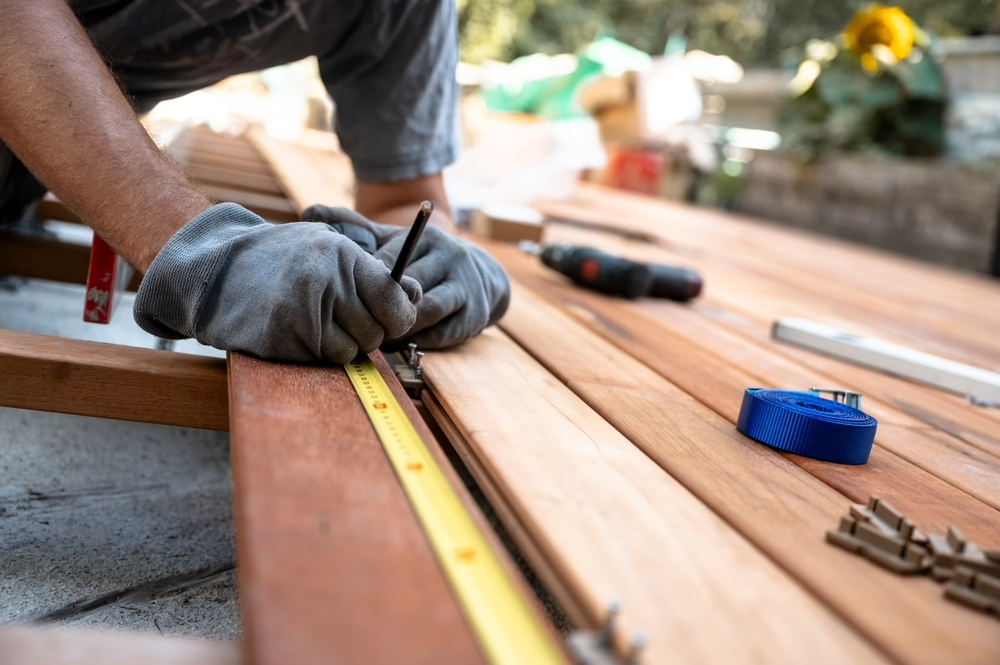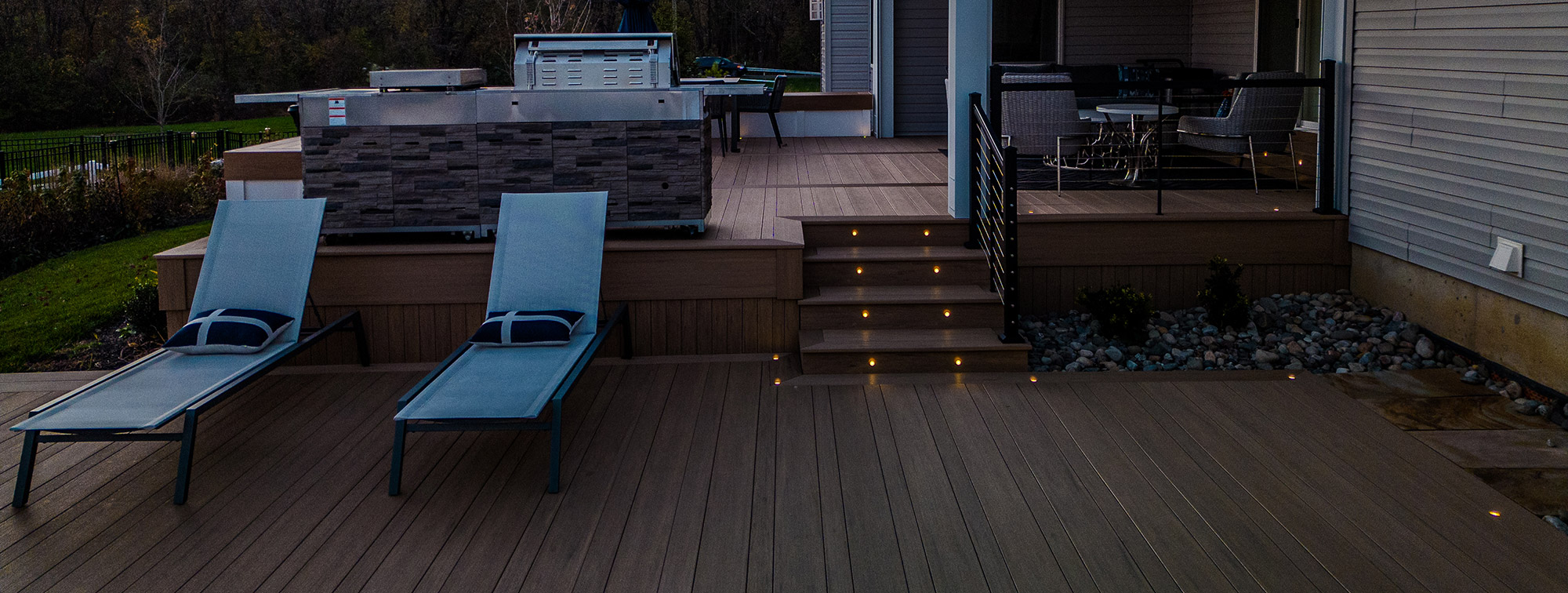
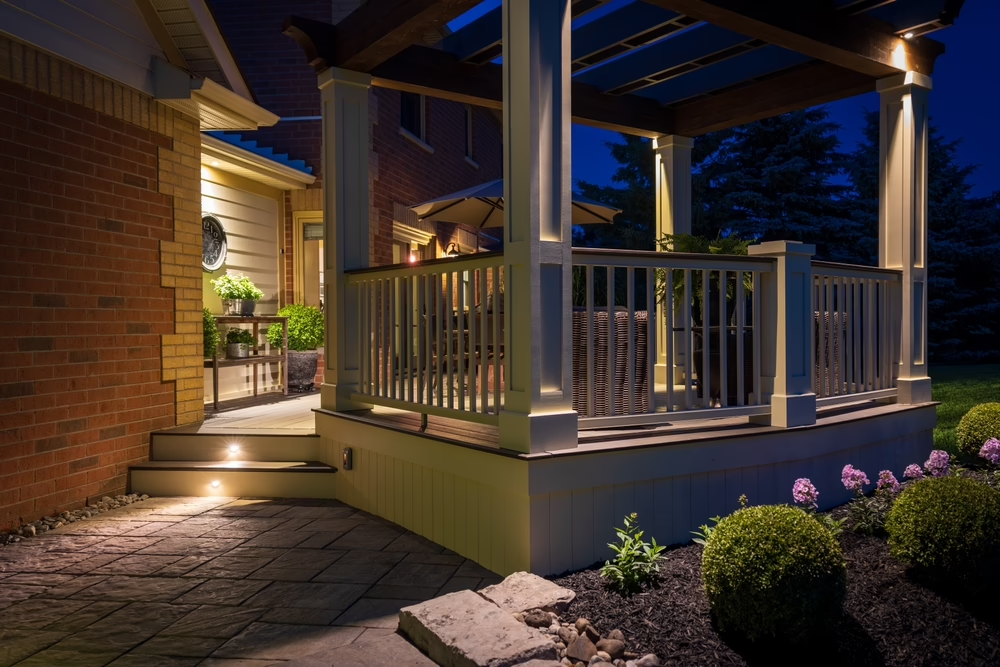

A deck stair tread needs roughly 1 to 2 foot-candles of light to be read clearly by someone carrying a tray, and a single 1.5-watt LED riser fixture delivers that without putting any brightness in a guest’s eye line. Getting there depends almost entirely on decisions made during framing, which is why deck contractors in Philadelphia pull low-voltage cable through the joists before a single board is fastened down. Retrofitting a lighting plan after the surface is screwed tight means surface-mounted wire, visible clips, and compromises nobody wants to look at for fifteen years.
Low-voltage systems run at 12 to 15 volts off a transformer, draw a fraction of the power of line-voltage floodlights, and can be handled safely without the conduit and inspection burden of 120-volt circuits. The design question is not whether to light the deck, but how many lumens go where, and at what height.
Wire Paths Get Drilled While The Framing Is Open
Cable routing is a framing-stage task. Holes of 1/2 to 3/4 inch get drilled through the center of the joist depth, keeping at least 2 inches of material above and below the bore so the structural capacity of the member stays intact.
Each planned fixture location should get an 18- to 24-inch service loop of slack cable, tucked and labeled so it can be found three weeks later when the rail goes up. Speaker wire for outdoor audio travels in the same pass, since opening the deck a second time for a different trade wastes a full day of labor.
- Direct-burial rated cable for anything touching soil or sitting inside a post sleeve
- Stainless or polymer staples set loose enough that the jacket is not pinched against the joist
- Labeled tags at every stub-out identifying zone, fixture type, and run length
- A dedicated chase to the transformer location, usually a rim joist near an exterior GFCI outlet
Stair Lights Carry The Safety Load
Steps are where poor lighting actually causes injuries, so they get the first allocation of the lumen budget. Recessed riser lights mount in the vertical face of the riser, roughly 2 to 3 inches below the tread nosing, throwing a soft wash forward across the tread below.
On a straight run of four or more steps, a fixture on every riser reads as even and intentional, while alternating risers save cost and still define the edge of each tread. Wider stairs benefit from paired stringer-mounted side lights instead, set 4 to 6 inches above each tread, which keeps the center of the walking surface clear of hardware.
Landings deserve their own fixture. A 90-degree turn in the dark is the single most common place a guest misjudges depth, and one recessed light in the adjacent guard post solves it.
Post Caps Set The Mood, Not The Visibility
Post cap lights put out 15 to 40 lumens each, which is enough to mark the perimeter of the deck and rarely enough to light the floor. Their job is spatial definition: they tell the eye where the deck ends, and the yard begins.
Spacing every 6 to 8 feet along the rail produces a continuous rhythm, though alternating posts on a long run avoids the runway effect that makes a backyard look like a parking apron. Warm color temperature in the 2700K range flatters wood tones and skin; anything above 3500K pushes the space toward a commercial feel.
Under-Rail Washes Are What Actually Light The Floor
LED tape or linear strip seated in an aluminum channel under the top rail cap, aimed down, is the most effective way to put usable light on the deck surface without a single visible bulb. The channel hides the diodes, a frosted lens diffuses the hot spots, and the eye registers a glow on the boards rather than a light source.
Mounted at standard guard height of 36 to 42 inches, the wash reaches roughly 4 to 6 feet onto the deck, which covers most traffic paths on a typical build. Under-bench and under-planter lighting works the same way and handles the interior zones that rail lighting cannot reach.
Glare Control Comes Down To Aim And Mounting Height
Seated eye height on a deck chair is roughly 44 inches above the surface, so any unshielded source between 36 and 60 inches is going to be stared into all evening. Fixtures in that band need a shield, a lens, or a downward aim, with the diode itself hidden from every seated sightline.
Full-cutoff and shielded fixtures also keep light out of neighboring windows and off the sky, a practice the International Dark-Sky Association has pushed for in residential design for years. A useful self-check is to walk the finished deck at night from four positions and look for any point source that reads as a bright dot rather than a soft glow.
Transformer Sizing And Voltage Drop
Total the connected wattage of every fixture, then size the transformer at roughly 125 percent of that figure to leave headroom for future additions. A typical 400-square-foot deck with riser lights, post caps, and two rail runs lands somewhere between 60 and 120 watts, which a 150-watt unit handles comfortably.
Voltage drop is the quiet failure mode. Runs longer than 50 feet on 14-gauge cable can lose enough voltage that the far fixtures read visibly dimmer and the LED drivers run out of spec.
- Use 12-gauge cable for runs past 50 feet and 10-gauge past 100 feet
- Keep total drop under 1.5 volts from transformer to the last fixture
- Wire in a hub or T configuration rather than one long daisy chain
- Use the 13V or 14V tap on a multi-tap transformer to compensate for longer runs
Zones And Controls Change How The Deck Gets Used
Three zones cover almost every build: stair and safety lighting, rail and ambiance lighting, and perimeter or landscape lighting below the deck. Separating them means the stairs can stay lit all night while the rail wash dims for a dinner, or the under-deck lights run alone for a quiet evening.
An astronomic timer tracks sunset through the year and beats a photocell for consistency.
Dimmers on the ambiance zones matter more than most homeowners expect, since the same rail lighting that feels right at 100 percent on a party night feels harsh for two people with a glass of wine.
Multi-Level And Rooftop Layouts Need Transition Lighting
Every change in elevation between deck levels needs its own marker, even a single step-down between a dining platform and a lounge area. Recessed lights in the face of the transition, or a continuous strip under the upper-level nosing, prevent the depth misjudgment that happens when two surfaces share a color and a finish.
Rooftop builds add a parapet or guard condition where fixtures must aim inward and down, since anything aimed outward lands in a neighbor’s bedroom window. Planter lighting and low-mounted perimeter fixtures work better up there than tall post caps, which read as a lit rooftop from the street.
Coordinating Lighting With Pool, Concrete, And Audio Trades
Conduit sleeves under a concrete patio or pool deck have to go in before the pour, and a missed sleeve means either a saw cut or a surface-mounted run. The same holds for feeds crossing from the house to a detached structure.
Expert General Contracting is building out its role as a full outdoor space specialist, coordinating pool, concrete, and other trades alongside the deck itself, which is largely about sequencing conduit and cable before anyone pours or fastens anything. Bucks County deck builders working on a combined deck and pool project should confirm bonding and clearance requirements with the pool contractor before lighting locations are finalized.
Frequently Asked Questions
How Many Lumens Should A Deck Light Produce?
Post cap and rail fixtures work best between 15 and 40 lumens, while stair riser lights fall in the 20 to 60 lumen range. Higher output is rarely better on a deck, because the eye adapts to darkness and a 100-lumen fixture at seated height becomes a glare source instead of an aid.
Can Lighting Be Added To An Existing Deck?
Yes, though expect 2 to 4 additional labor hours per zone compared with a new build, since boards near the rail often need to be lifted to route cable. Solar post caps avoid the wiring entirely but deliver inconsistent output through the shorter days of late fall and winter.
What Color Temperature Works Best Outdoors?
2700K warm white is the standard choice for residential decks and matches most interior fixtures visible through adjacent windows. Values above 3500K read blue-white at night and tend to make composite decking look gray regardless of its actual color.
Talk Through A Lighting Plan For Your Deck
Lighting decisions are cheapest and cleanest when they happen alongside the framing plan, so the earlier a layout gets drawn, the fewer compromises end up in the finished deck. To talk through your project, contact Expert General Contracting.